
05 Nov Laser therapy for foot and ankle pain: meet our ASA MLS® Mphi 75.5
Laser therapy for foot and ankle pain: meet our ASA MLS® Mphi 75.5
If heel pain, a stubborn Achilles or an old ankle sprain has been slowing you down, you may have heard us mention laser therapy. Here’s a plain-English look at the laser we use in the clinic, the ASA MLS® Mphi 75.5, what it does, and where it fits into your care.
What is MLS® laser therapy?
MLS stands for Multiwave Locked System. It’s a form of photobiomodulation – using specific wavelengths of light to stimulate the body’s own healing processes in the tissues under the skin.
Most therapy lasers use a single wavelength. MLS® technology, developed by Italian manufacturer ASAlaser, combines two near-infrared wavelengths – one continuous (808 nm) and one pulsed (905 nm) – and synchronises them in a patented pulse. The aim is to target pain, inflammation and swelling at the same time, while keeping the treatment comfortable and safe.
ASAlaser has been making therapy lasers since 1983, and MLS® lasers are used by podiatrists, physiotherapists and sports medicine teams around the world.
About our Mphi 75.5
The Mphi 75.5 is one of the more advanced units in the MLS® range. A few things set it apart:
• 75 W peak power handpiece. More peak power allows energy to be delivered efficiently, which can mean shorter treatment times.
• “Hands-free” multi-diode applicator. Its Charlie Orange applicator holds three 75 W MLS® sources on a fixed arm, covering a 5 cm treatment area. This lets us treat larger areas – like the whole heel or the length of the Achilles – evenly and consistently.
• Two independent channels. The handpiece and the hands-free applicator can be run at the same time, so we can treat two areas in one session.
• Precision light guide. A fine cone-shaped attachment lets us focus on small, specific points.
• Saved protocols. Treatment settings are tailored to the condition and the tissue being treated, and can be repeated precisely at each visit.
What might we use it for?
Laser therapy is never a stand-alone fix, but it can be a helpful part of a treatment plan for conditions such as:
• Plantar fasciitis and heel pain
• Achilles tendon pain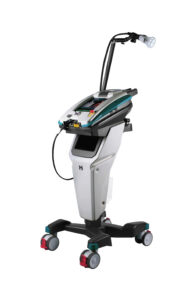
• Ankle sprains and ligament injuries
• Bursitis
• Arthritic and joint pain
• Swelling and bruising after injury or surgery
• Sports injuries and overuse niggles
• Nerve pain and neuropathy
Your podiatrist will let you know whether laser therapy is likely to suit your condition, or whether another approach would be better.
What to expect at a laser appointment
• It’s quick. Most treatments take only a few minutes per area.
• It’s comfortable. Most people feel nothing at all, or a mild, gentle warmth. There are no needles and no downtime – you can go straight back to your day.
• Eye protection. You and your podiatrist will both wear safety glasses during treatment, as with all therapy lasers.
• A course of sessions. Laser therapy usually works best as a series of treatments over a few weeks. We’ll discuss a plan with you and review your progress as we go.
Everyone responds differently, and results can’t be guaranteed. We’ll be upfront with you about what’s realistic for your situation.
Part of a bigger plan
Laser therapy works best alongside the other things that address why your foot hurts in the first place – footwear advice, orthotics, strapping, stretching and strengthening, and changes to training load. Think of it as a tool that may help settle pain and support healing while we work on the underlying cause.
Is laser therapy safe for me?
MLS® laser therapy is non-invasive and generally very well tolerated. There are some situations where it isn’t appropriate, such as treating over a growth plate (for children) or directly on the abdomen of a pregnant person.
Book an appointment
If you’re dealing with foot or ankle pain and would like to know whether laser therapy could be part of your treatment, book an appointment with one of our podiatrists. We’ll assess your issues, explain your options and put together a plan that suits you.
This article is general information only and isn’t a substitute for individual advice. Please speak with your podiatrist about your own situation.
https://www.asalaser.com/sites/default/files/documenti/catalogo_mis_eng.pdf
https://www.sportspodiatry.com.au/services
Sorry, the comment form is closed at this time.